
A lot of marketing advice begins with the assumption that your current way of getting clients is broken.
For many interior designers, it is not.
Referrals work.
Past clients return.
Builders introduce designers to homeowners.
Architects make recommendations.
Clients tell their friends.
Business of Home describes word of mouth as one of the strongest sources of business in the design industry, and its coverage shows designers relying heavily on referrals, relationships, Instagram, and repeat business to keep their pipelines moving.
So if referrals are consistently bringing you good projects, there is no reason to replace them simply because somebody told you that you need a “lead generation system.”
The more useful question is:
Are referrals giving you the business you want, with enough consistency for where you want the firm to go next?
If you are fully booked with the right projects
You may not need more acquisition right now.
That is a perfectly valid answer.
If the calendar is full, clients are a good fit, margins are healthy, and you have no desire to increase capacity, spending aggressively to create more inquiries is difficult to justify.
Your constraint is no longer demand.
It may be time.
Staff.
Operations.
Project capacity.
Or simply your own preference for how large you want the studio to become.
If you are repeatedly turning away ideal projects because the team cannot take them, I would examine capacity before increasing the marketing budget.
More demand does not solve a delivery constraint.
That does not mean disappearing
There is a difference between actively trying to generate more demand and maintaining the assets that keep your firm visible.
A busy period is a good time to collect material that becomes useful later.
Photograph completed projects.
Ask happy clients for reviews.
Keep the portfolio current.
Stay in touch with the referral relationships that matter.
Document the kind of work you want more of.
Keep the website accurate.
Publish something useful when you genuinely have something to say.
None of this requires turning marketing into another full-time job.
It simply prevents the business from having to restart from zero if the pipeline changes six months from now.
Business of Home has covered firms that were accustomed to steady work and then experienced a sudden slowdown in new projects. Its 2026 reporting includes a designer whose business had historically relied on referrals before that stream weakened significantly.
That does not mean referrals are unreliable.
It means no source of demand is guaranteed to behave exactly the same forever.
Referrals and marketing are more connected than they look
A referral frequently creates the introduction.
The website still helps close the credibility gap.
Business of Home reported in July 2026 that even when somebody hears about a designer through word of mouth, the next move is often to look through the firm's website and portfolio.
Houzz Pro has reported a similar pattern: more than 60 percent of homeowners who received a professional referral still conducted their own online research, including looking at portfolios and reviews.
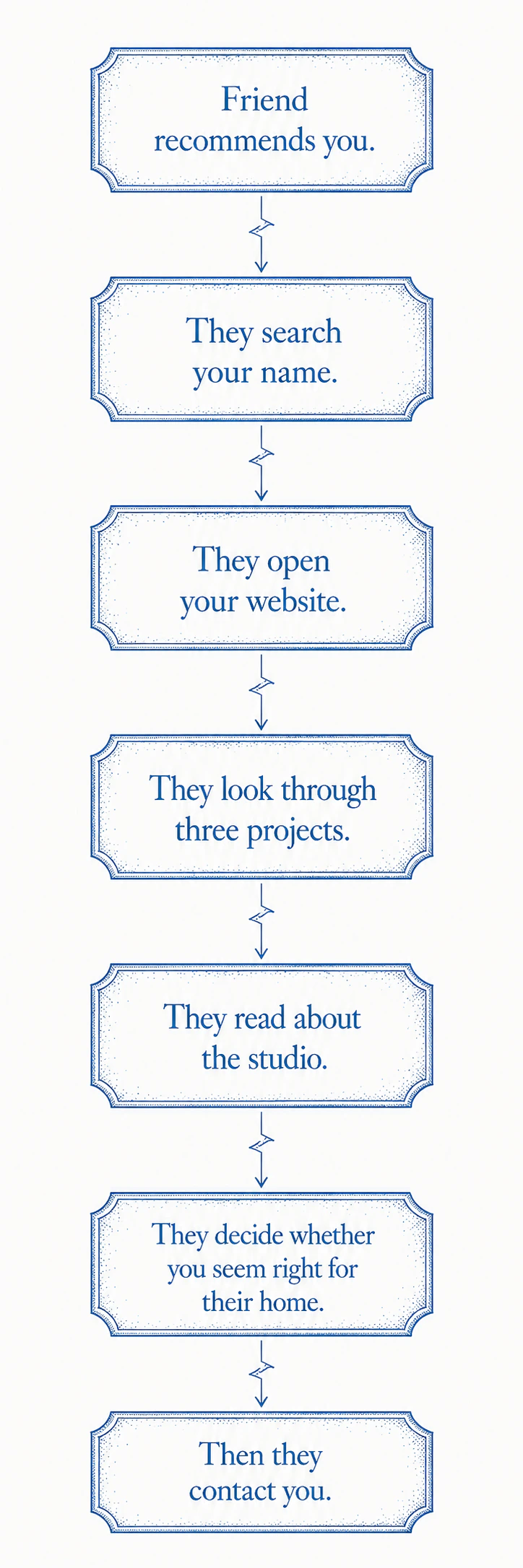
So a referred prospect may experience your firm like this:
Friend recommends you.
They search your name.
They open your website.
They look through three projects.
They read about the studio.
They decide whether you seem right for their home.
Then they contact you.
The referral created trust.
Your marketing either reinforced it or weakened it.
That is one reason I would never think of referrals and digital marketing as opposing strategies.
The strongest firms can use both.
Marketing becomes more useful when the business is changing
Imagine referrals are working, but you want different projects.
Your average project minimum has increased.
You want to work in another city.
You have hired another designer and now have more capacity.
You want fewer decorating projects and more full-home work.
You want to move toward a different architectural style.
You want to work with a different kind of client.
Your old referral network may continue doing exactly what it has always done.
It may keep sending the version of the business people already know.
That is when deliberate marketing becomes particularly useful.
You can show the market where the firm is going next.
You may also want more control
There is another reason to market even when referrals work.
Planning.
A referral arrives when somebody decides to refer.
You cannot schedule that.
You can encourage referrals and maintain strong relationships, but you do not control the exact timing.
Additional channels give the business more sources of opportunity.
Search.
Content.
Press.
Partnerships.
Advertising.
Social.
Email.
You do not need all of them.
You may only need one or two that complement what already works.
The goal is not to replace a strong referral engine.
The goal is to avoid asking one channel to carry the entire future of the business.
So, do you need more marketing?
If you are fully booked with exactly the work you want and have no intention of growing, probably not much.
Serve the clients well.
Protect the quality of the work.
Improve operations where needed.
Keep enough visibility in place that the firm does not disappear between projects.
If you are fully booked but planning to expand, start thinking about the future pipeline before the new capacity arrives.
If referrals are good but inconsistent, build another source of demand alongside them.
If referrals keep bringing yesterday’s ideal project while the firm has moved on, update how the market sees you.
And if referrals have started slowing down, do not immediately buy the first marketing tactic somebody offers you.
Find out where the actual gap is first.
That might be awareness.
Positioning.
Portfolio.
Website.
Follow-up.
Or demand itself.
Good referrals are an asset.
Build around them.