
There is no useful rule that says an interior design website should be redesigned every two years.
Or three.
Or five.
A website can be several years old and still represent the firm beautifully.
A newer website can already be wrong.
Age is a weak reason to rebuild something.
The better question is:
Does the website still represent the business accurately and help the right prospective client move toward an inquiry?
That is what I would examine first.
Your website matters even when most business comes from referrals
Interior design is unusually visual.
A prospective client can hear wonderful things about you and still want to see the work for themselves.
Business of Home describes exactly that behavior: a potential client may discover a designer through Instagram or word of mouth and then immediately visit the website to see whether the portfolio matches what they are looking for.
Houzz Pro has also reported that more than 60 percent of homeowners who receive a professional referral still do additional research online.
Your website therefore does more than generate cold leads.
It also receives people who already know your name.
The job is different, but just as important.
It needs to confirm that the recommendation they received makes sense.
Redesign when the website represents an older version of the firm
This is probably the clearest reason.
Maybe the projects on the website were excellent three years ago.
But they are no longer the projects you want next.
Perhaps your budgets have increased.
Your aesthetic has evolved.
The firm now takes larger projects.
You have stopped offering a service that still dominates the website.
You work in different markets.
You have built a team, but the site still looks like a solo practice.
Your positioning has become more sophisticated, while the website still speaks to the client you were trying to attract when the business began.
At that point, the website is not merely dated visually.
It is giving the market outdated information.
Business of Home makes a similar point about portfolios: the projects a designer chooses to show can directly influence the kind of work the firm attracts next.
So sometimes the redesign starts with a much harder question than colors or typography.
Which version of the firm should this website be selling?
Redesign when you have stopped feeling confident sending people to it
This is less measurable than traffic or conversion data, but it still matters.
If somebody asks for your website and your first instinct is to explain that it is old, that the portfolio is out of date, or that “we are actually working on a new one,” something is probably misaligned.
The same applies when people who know the business well keep noticing it.
A past client tells you the website does not reflect the quality of the work anymore.
An architect or builder says the studio feels much stronger in person than it does online.
A new client mentions that they almost did not inquire because the website felt dated or unclear.
Or you simply notice that you are increasingly reluctant to send people there.
One comment on its own is not a reason to rebuild a website.
A repeated pattern is worth paying attention to.
There is also a difference between being bored with your website and no longer believing in it.
If you are tired of a typeface you have seen every day for three years, that may be a small design problem.
If the positioning feels wrong, the portfolio is organized around work you no longer want, the structure no longer fits the business, the copy needs to be rewritten across the site, and the underlying technology makes everything difficult to change, patching individual pages may stop making sense.
That is when rebuilding from scratch can be the cleaner decision.
You get the opportunity to reconsider the structure, messaging, visual system, portfolio, user journey, and technical foundation together instead of repeatedly fixing a website that was built for a different version of the firm.
A full rebuild is a larger investment.
But sometimes continuing to improve the wrong foundation is the more expensive choice.
Redesign when good prospects are arriving but the site is creating friction
Traffic by itself is not the goal.
Imagine a lot of the right people already visit the site.
They arrive from Google.
Instagram.
Press.
Referrals.
Or advertising.
But very few appropriate inquiries follow.
Now the website deserves closer attention.
Can someone quickly understand what the studio does?
Is the geography clear?
Are the services clear?
Does the portfolio reflect the target client?
Does the site give enough context around project type and scale?
Is the contact path obvious?
Does it work properly on a phone?
Does anything look broken, unfinished, confusing, or difficult to navigate?
These are not all reasons for a complete redesign.
They are reasons to diagnose the website.
Sometimes the problem is one page.
Sometimes it is the copy.
Sometimes the portfolio order.
Sometimes the inquiry form.
Sometimes there is enough wrong with the structure that rebuilding becomes the cleaner solution.
Redesign when the website itself has become difficult to operate
A website should not require a small engineering project every time you want to add a completed project.
If the technical system makes it difficult to update work, publish useful content, change services, add team members, or keep basic information accurate, the website can start holding the business back.
This is particularly relevant when the marketing strategy has changed.
Perhaps you now want individual project pages.
Articles.
Local pages.
Case studies.
A more useful inquiry process.
Better analytics.
A faster site.
The existing website may never have been built for those things.
At that point, a rebuild can be an infrastructure decision as much as a visual one.
Do not redesign because you are bored
Designers spend their careers noticing details.
That can make their own website difficult to judge.
After seeing the same homepage hundreds of times, almost anything starts feeling old.
Your prospective client is not looking at it for the four-hundredth time.
They may be seeing it for the first.
If the site still represents the work, communicates the business clearly, performs well, and attracts the clients you want, familiarity alone is not a good reason to replace it.
Make a change because the business needs one.
Not because you are tired of looking at the font.
Do not redesign a traffic problem
This one is important.
If hardly anybody visits the website, a prettier website does not automatically solve that problem.
You may need search visibility.
Advertising.
PR.
Partnerships.
Content.
A stronger referral network.
Or another acquisition channel.
A redesign can make the destination better.
It does not automatically create the journey to it.
There are exceptions.
A technically poor website can affect search visibility.
A site may be impossible to expand with useful content.
The structure may be holding SEO work back.
But if the existing website is technically sound and the real issue is simply that nobody knows it exists, solve the discovery problem.
Do not redesign when the real problem is the portfolio
A website cannot manufacture projects you have not photographed.
If your strongest work is missing, the first investment may be photography.
If the portfolio contains twenty projects but only four represent the work you want more of, curation may matter more than a new layout.
Houzz Pro describes the portfolio as evidence of a designer's ability and a major way prospective clients determine whether the designer's aesthetic and experience fit what they need.
Beautiful web design can frame the work.
It cannot substitute for it.
Sometimes the right answer is a smaller intervention
A full rebuild gets a lot of attention because it is visible.
Smaller changes can be commercially significant.
Rewrite the homepage.
Remove work that no longer fits.
Change the order of projects.
Clarify the services.
Improve the inquiry form.
Add testimonials.
Improve mobile behavior.
Fix performance problems.
Make the contact path easier.
Add one strong case study.
Update the photography.
A current website with a few weak areas may need refinement.
A website built around the wrong business may need a rebuild.
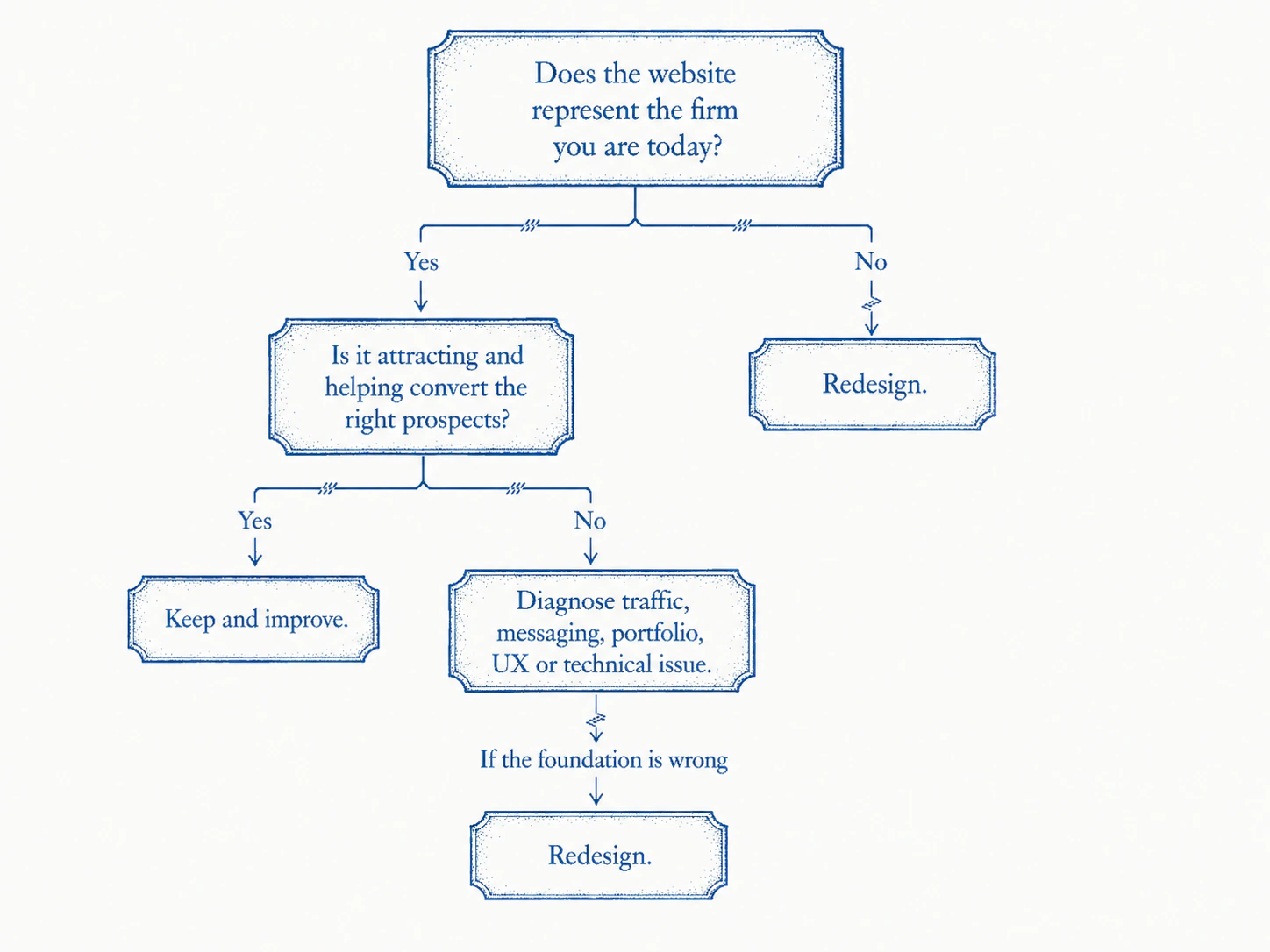
A useful way to decide
Before commissioning a new interior design website, I would answer these questions without looking at the visual design first.
Who are we trying to attract now?
What projects do we want more of?
Does the existing portfolio support that?
What does a good prospective client need to understand before contacting us?
Where are visitors currently coming from?
What are they doing once they arrive?
What can the current website not do that the business now needs?
Once those answers are clear, the scope usually becomes easier to see.
Maybe you need an entirely new website.
Maybe you need better photography and sharper copy.
Maybe you need more traffic.
Maybe the current site is doing its job and the smartest decision is to leave it alone.
A redesign should solve a business problem.
If you cannot name that problem yet, start there.