
Google Ads can work very well for an interior design firm.
They can also turn an expensive click into an inquiry for a project you would never take.
The difference usually starts before the campaign is built.
A search campaign can put your firm in front of someone actively looking for an interior designer. That is valuable.
But Google Ads only solves the first part of the problem.
Someone still has to click.
Like what they see.
Understand what you do.
See themselves as the kind of client you work with.
And decide that contacting you is worth the next step.
So before asking whether Google Ads work for interior designers, I would ask a different question.
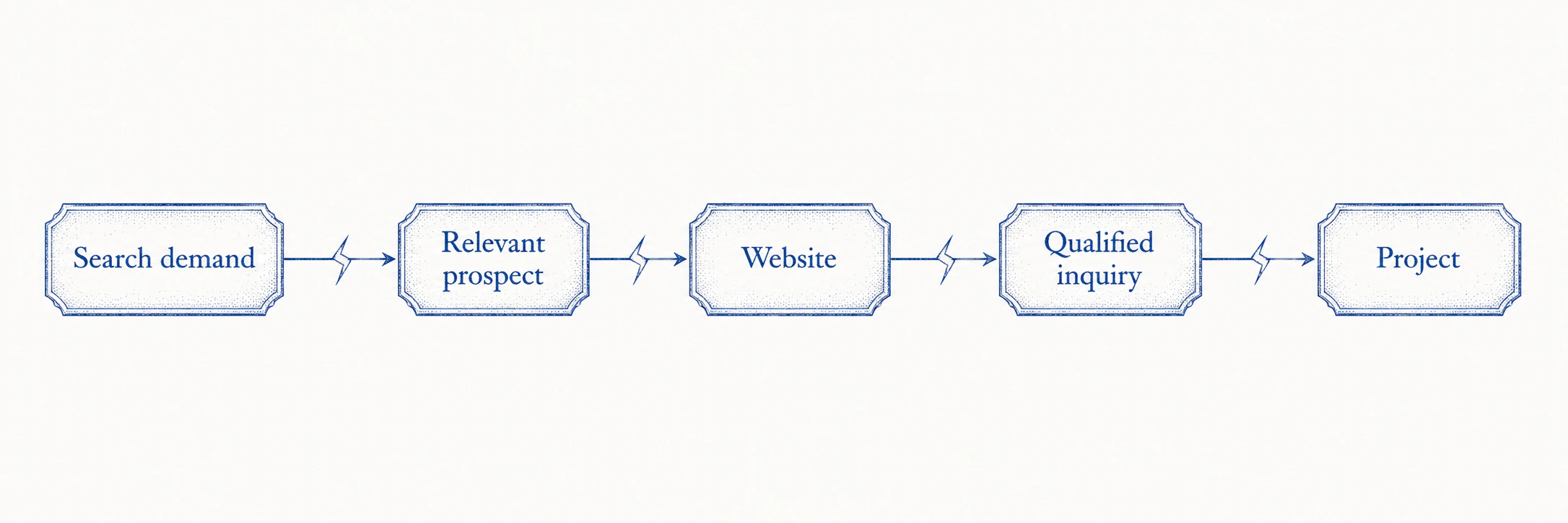
Is your business ready to turn search demand into the kind of project you actually want?
First, is there enough of the right search demand?
Search advertising works best when people are already searching for something close to what you sell.
That sounds obvious, but it matters more in interior design than it does in many categories.
“Interior designer” can mean very different things.
A full-home residential designer.
A decorator.
A kitchen designer.
An e-design service.
A commercial firm.
Someone looking for a job.
Someone looking for ideas.
Someone who wants help choosing paint.
The keyword you bid on and the search that actually triggers the ad are not always identical.
Google Ads Help explains that keyword matching can show ads for searches related to a keyword's meaning, and that the Search Terms report lets advertisers see what people actually searched before triggering an ad. Negative keywords can then be used to remove irrelevant searches.
For an interior design firm, that makes the first few weeks of search-term data especially important.
You are not only asking:
“Did this keyword get clicks?”
You are asking:
“Who were these people actually looking for?”
Then look at the economics
A click is not a client.
A form submission is not necessarily a qualified lead.
A qualified lead is not necessarily a project.
Work backwards from the business.
What kinds of projects do you want more of?
What is an appropriate design fee or project value?
How many genuinely qualified conversations normally turn into signed projects?
How much are you comfortable investing to acquire one of those projects?
You do not need perfect numbers before starting.
You do need enough understanding to know whether the campaign has any chance of making commercial sense.
This is why generic claims such as “Google Ads cost X for interior designers” are not very useful.
The same cost per click can be acceptable for one studio and completely uneconomical for another.
Your website matters before you buy the traffic
One of the easiest ways to waste advertising budget is to send good traffic to the wrong page.
Google Ads Help treats landing-page experience as part of ad quality, including relevance, usefulness, navigation, and whether the page matches what the person expected after clicking the ad.
For an interior designer, the commercial question is even simpler.
If somebody searches for a high-end residential interior designer in your city and lands on your site, can they quickly understand:
What kind of work you do?
Where you work?
What level of project you are suited to?
Whether your portfolio resembles the kind of work they want?
What makes the firm worth contacting?
What happens next?
A campaign can generate attention.
It cannot rescue a website that creates doubt at the exact moment somebody is deciding whether to inquire.
Measure qualified leads, not just form submissions
This is one of the most important parts of running Google Ads for an interior design firm.
Imagine two campaigns.
Campaign A produces 15 inquiries.
Campaign B produces 5.
Campaign A looks better until you discover that 14 of its inquiries were unsuitable and three of Campaign B’s five were serious projects within your target scope and budget.
Lead volume alone would have told you the wrong story.
Google Ads Help distinguishes between a qualified lead and a converted lead, and explains how businesses can send later-stage lead information back into the platform.
For a design firm, that means measurement can eventually go beyond:
“Someone filled in the contact form.”
You can track whether the inquiry became qualified.
Whether a consultation happened.
And, with the right setup, whether the opportunity ultimately became a client.
That is much closer to the number the business actually cares about.
When I would hesitate to run Google Ads
I would be cautious if your website no longer represents the level of work you want.
I would be cautious if you do not yet know which projects you are trying to attract.
I would be cautious if your services are difficult to explain and the website does not help clarify them.
I would be cautious if nobody is going to review search terms, improve targeting, and remove irrelevant traffic.
I would be cautious if all form submissions are being counted equally regardless of lead quality.
And I would be particularly cautious if your firm is already at capacity.
If the studio cannot take another good project, creating more demand may simply create another problem.
When Google Ads becomes much more interesting
The conditions are better when the firm knows what it wants.
There is meaningful search activity in the market.
The geography is clear.
The portfolio supports the type of project being advertised.
The website gives a prospective client enough confidence to inquire.
The studio has capacity.
And you can measure what happens after the form is submitted.
At that point, Google Ads can become a useful source of demand rather than an experiment in buying traffic.
The question I would ask before spending anything
Do not begin with:
“How much should we spend?”
Begin with:
“What would have to be true for a click from the right person to become a good project for this firm?”
Then work backwards.
Search intent.
Targeting.
Message.
Website.
Qualification.
Follow-up.
Measurement.
If those pieces are in reasonable shape, Google Ads may be worth testing.
If they are not, fixing them first may produce a better return than increasing the ad budget.